Frame houses – introduction to technology
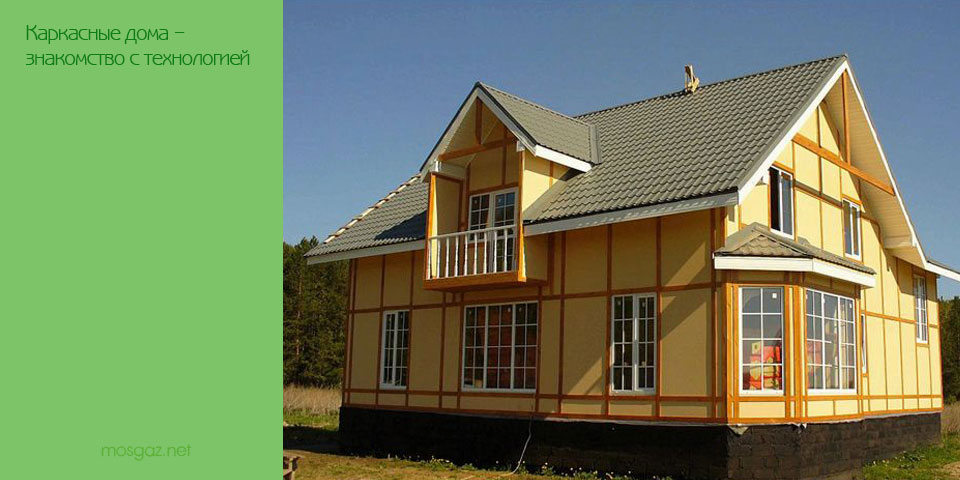
Firstly, frame houses are associated with affordable housing. However, not everyone fully understands how the technology works. Construction is surrounded by myths and contradictory facts. Understand the essence of the method, explain the overall frame solution, refer to design aspects and user reviews, and give an objective assessment of the rapidly receding structure.
Contents of the article:
- Advantages of frame structures
- Debunking myths: controversial issues
- Weaknesses of a frame house: comparison with alternative technologies
- Popular design solutions
- Experience in building a frame house: the reality of self-assembly
- Reviews from residents about frame houses
The concept of frame construction
Budget versions of House of Commons construction are especially popular in the USA and European countries. However, compatriots increasingly prefer faster means.
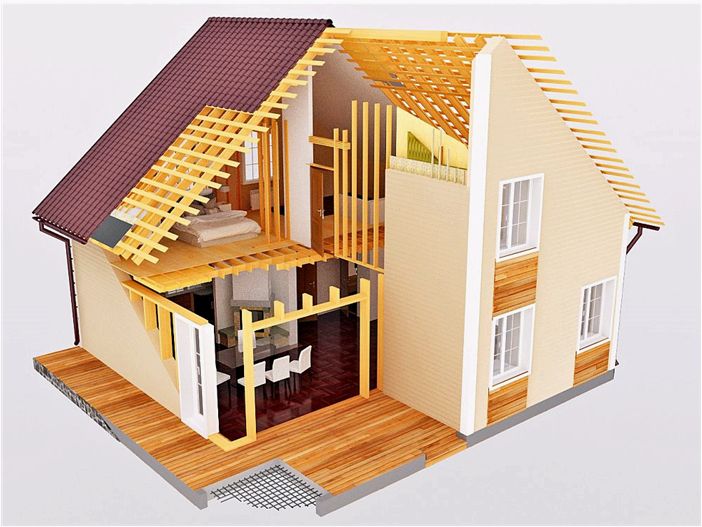
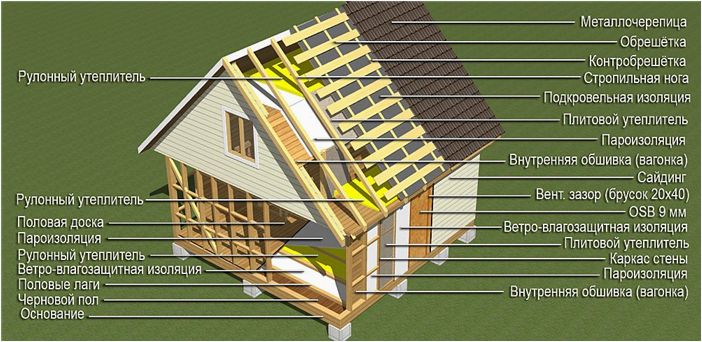
The nature of the technology is determined by its name. The foundation is a frame assembled from wooden supports or metal profiles. The beam structure, including racks, is attached to the prepared foundation, and the voids in the planes of the frame walls are closed with heat-efficient materials.
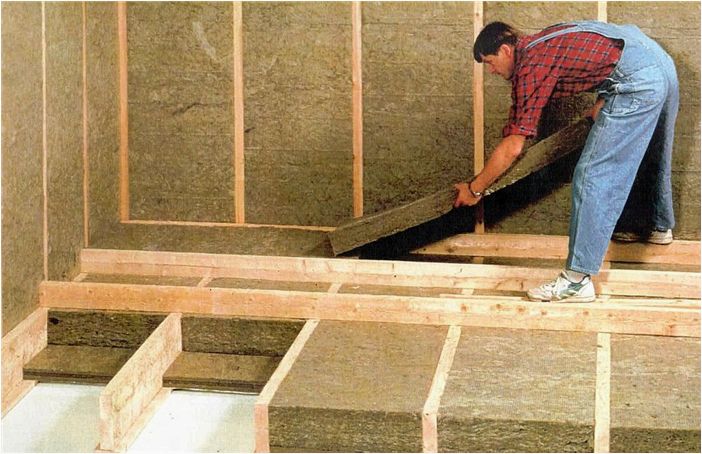
Insulation, steam and waterproofing are laid between the external and internal walls. Finishing materials on the facade of the house include: plaster or paneling. OSB board, cement-brown mat or durable plywood are used as sheathing. The role of a heat insulator is performed by slabs made of mineral wool or wood fiber – “warm wood”.
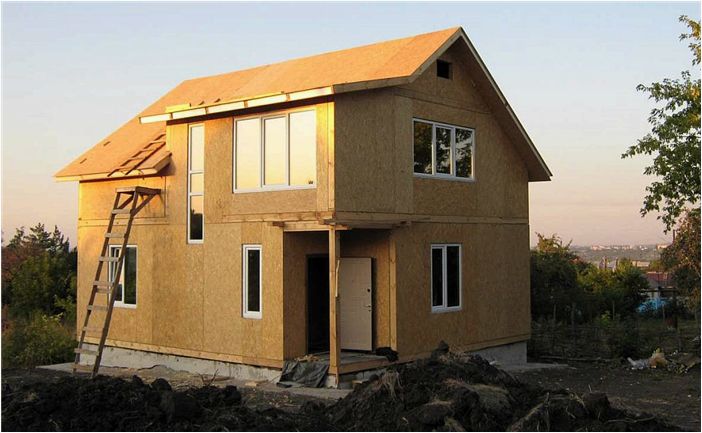
Simple buildings can withstand the vagaries of nature, mechanical shocks and withstand both temporary summer houses and year-round housing. The service life of a frame house depends primarily on the quality of the source materials and compliance with construction technology.
Features of prefabricated buildings
Frame houses are a relatively new direction in construction. Therefore, there are many myths and speculations about innovative technologies and the operation of “light” structures. We describe the pros and cons of framing and try to separate prejudices that are far from the real facts.
Advantages of frame structures
The list of arguments in favor of prefabricated houses is impressive. We can highlight the most important competitive advantages:

- Price. The cost of materials for brick walls, houses made of ventilated concrete, or timber is significantly higher. Furthermore, frame houses, due to their lighter weight, do not require significant foundation excavation. Additional savings are achieved through the initial construction phase.
- Construction speed. A team of 110-150 square meters of cottage construction can be built in 3-4 months. The simplest country house will be ready in two weeks.
- Versatility. Frame technology has been implemented on various soil types, including peat and silted soils. The key is to choose the right foundation type—the foundation must be of a suitable type.
- Ease of installation. The house is assembled using construction principles, and no special equipment is used in the work process—the components of the elements are relatively lightweight and compact.
- Mobility. Small structures can be moved to new locations if necessary.
- Ease of redevelopment. The configuration and layout of internal sections can be changed, as they are not portable.
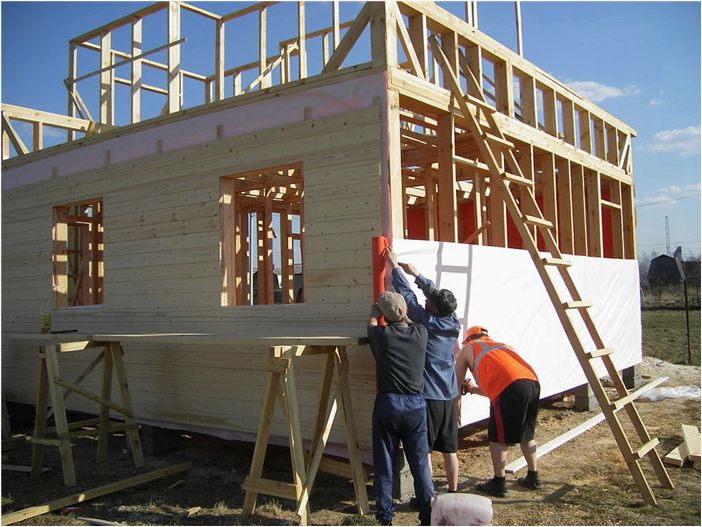
Additional advantages: no building settlement, no variations in building shape, and zero-touch work. Pre-poured foundations allow construction to continue in sub-zero temperatures, as there is no “wet” process.
Debunking myths: controversial issues
The lack of objective information and operating experience are the main reasons for mistrust of frame houses. Some claims are incorrect and require refutation.
- Vulnerability. According to regulatory requirements, construction lasts 30-50 years. These indicators are determined by the quality of the frame and the safety of the insulation. This must ensure complete protection of the supporting columns and thermal insulation from moisture. In the US, many houses have been standing since the early 19th century.
- Cold Winter. A standard 15-20 cm layer of insulation provides a U-value of 2. 9-3. 3 m*°C/W, while additional external thermal insulation increases this value to 4. 7 m*°C/W. The choice of insulation option depends on the local climate. Energy-efficient homes are suitable for cold climates with harsh winters.
- Frame houses are like thermos bottles. Despite the high need for insulation, frame buildings are constructed using micro-brush fiber insulation with a wood frame. However, in addition to natural ventilation, it is better to provide forced ventilation to maintain a healthy indoor climate. This requirement is especially important when heating houses with polystyrene and its derivatives.
- Toxicity. The structural elements of high-quality buildings use only environmentally friendly materials such as wood, metal, rock wool, gypsum board, OSB, and neutral insulation films. The potential for toxic materials is hidden in cheaper options. However, such dangers are not unique to frame construction.
Weaknesses of a frame house: comparison with alternative technologies
In some respects, fast-build, intelligent methods are inferior to traditional brick and aerated concrete construction.
- Low-rise. Low-rise houses can be built independently. If you want a cottage with an attic, you will need to hire professionals. It’s best not to build houses more than two stories high using frame technology.
- Low strength. According to this criterion, prefabricated structures are inferior to brick and log houses. The building will withstand natural forces (wind gusts, heat waves, etc.) well, but may not withstand those who intend to destroy the walls or the elements.
- Fire hazard. Despite the treatment of the wooden frame with a fire retardant impregnation, the risk of fire and the speed of fire spread in a prefabricated house are greater than in a brick or aerated concrete house. The use of modern fire protection systems somewhat mitigates this drawback.
- Poor sound insulation. Sound from the street and adjacent rooms mainly penetrates into the room. Noise reduction measures are partially effective – vibrations and the harshness of walking on the stairs can be heard from below.
Popular design solutions
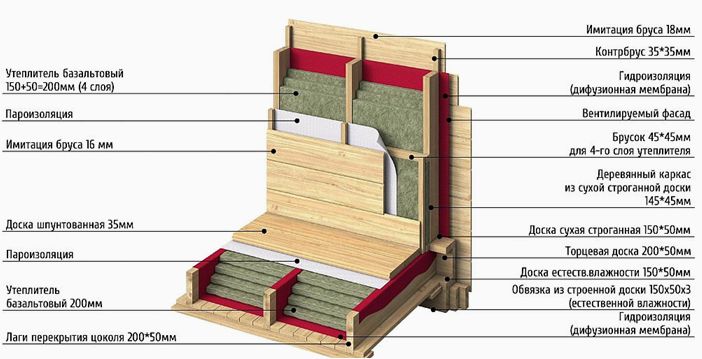
The basic construction principle for frame houses is uniform. Between the frame studs is insulation, protected on the inside by a vapor barrier film and on the outside by a waterproof membrane. On both sides, the “pies” into which the heat is inserted are covered with a rigid covering. However, there are various construction methods and design differences.
Conventionally, all frame structures can be divided into two categories: frame and thyroid. To build the first, the frame is first assembled, and then the sheathing is insulated. The second is built from ready-made factory panels. The functions of various technologies are analyzed.
“Platform” – Canadian method
This technology has taken root in Canada and Finland. This method involves assembling elements on a platform – a rough version of the first floor or floor slab. Fragments of the walls of the house are made on site with your own hands or ready-made components are used.
The design of the platform includes the construction of the poem. The floors are assembled from carpets and OSB, the walls are prepared and installed. The base of the second floor or attic is placed on top.
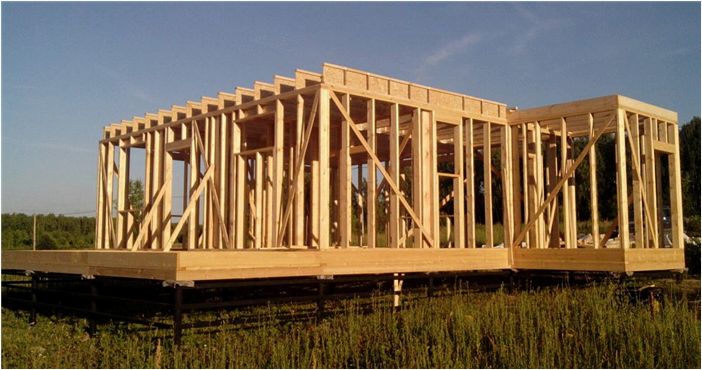
- Used in self-construction of small houses.
- The maximum size of the structure is 10-12 m.
- Extensions and complex shapes are not allowed.
Each of the vertical panels acts as a load-bearing element, so redevelopment of the “platform” house is impossible.
Half-timbered frame – German technology
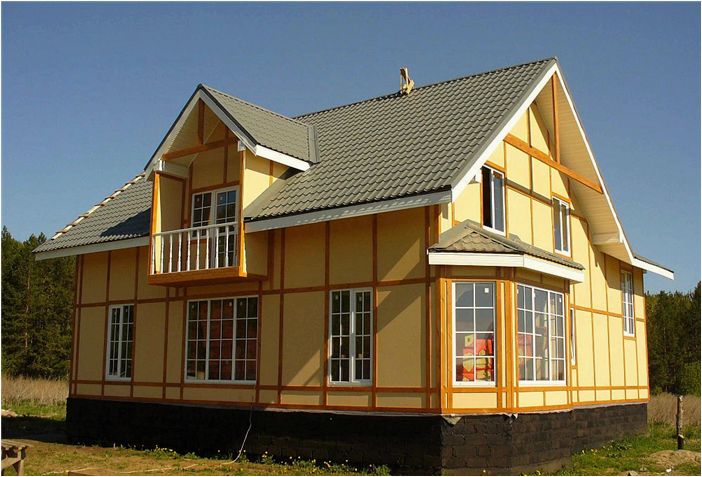
One of the oldest methods common in Europe. Wall sections are formed from ukins, vertical posts and horizontal beams. The wooden frames are not hidden behind the skin, but stand out from the outside and emphasize the delicacy of the house.
The basis of the structure are thick beams (100*100 mm, 200*200 mm) – they form a rigid and very durable frame. In Fachver houses, the “main” takes on the entire load, and the roof of the box represents a single power supply circuit. Thanks to this distribution, the structures are very strong and durable.
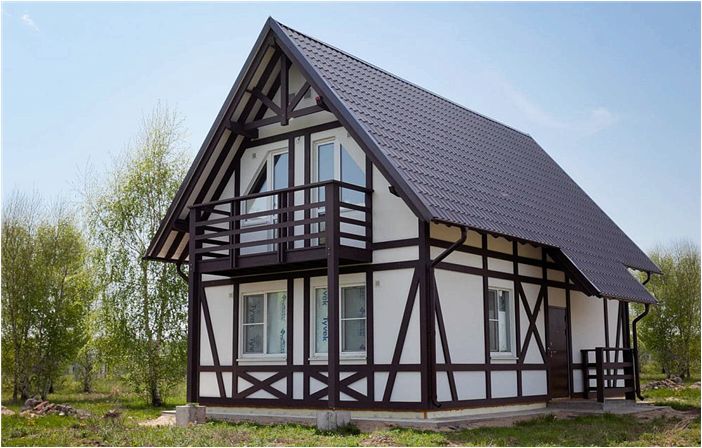
- Complexity of construction – Fahak technique allows experienced carpenters.
- Possibility of building large areas less than 20*30 m wide and up to 3 floors.
- Possibility of presenting the exterior.
The technology is not particularly popular among its compatriots due to its affordable cost and ease of construction, due to the lack of two key aspects of frame house construction.
Finnish house – frame-frame structure
The Scandinavian option is considered the most suitable for free-standing structures of small buildings. The maximum permissible plan size is 12*10 m. As a rule, this is enough for the construction of a seasonal country house or a full-fledged permanent residence.
A special feature of the design is the uniform distribution of the load on all sides of the box. The power section occupies the roof. Frames are built from logs or planks and form an open frame. After installing the entire structure, insulation begins.
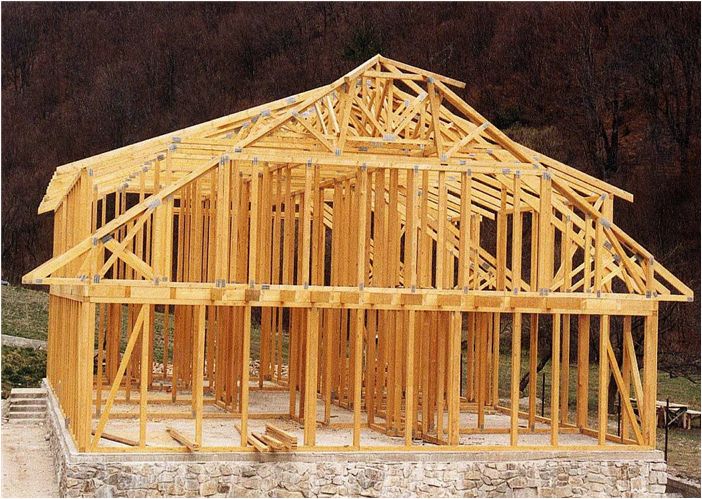
The main advantages of Finnish technology:
- Small budget for construction.
- Ease of operation;
- Possibility of completion.
Limitations and nuances of building frame houses:
- Power sheathing runs along the internal walls – this requirement limits the possibility of redevelopment.
- The maximum vertical step of the stand is 50 cm.
- Second floors are allowed.
DOK technology – maximum insulation
One of the promising trends in house building is the use of two-volume frames (DFC). The support posts are staggered to minimize the appearance of cold bridges. They are double skinned with support beams and the space between them is filled with thermal insulation.
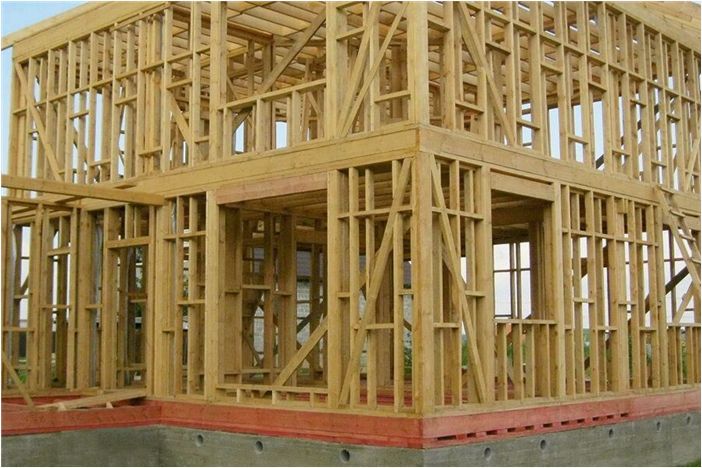
This solution increases the cost of the structure, but significantly increases the energy efficiency and strength of the walls. A square meter of double-volume frame can withstand about 500 kg – an indicator comparable to a stone building.
To prevent condensation, the house is equipped with a ventilated facade.
Sandwich panel houses
The number of frame buildings made of sandwich panels or SIP (structured slabs) is constantly growing. This is due to the availability of materials, their excellent technical and operational qualities and ease of processing.
- The panels consist of insulation (expanded polystyrene) and are surrounded on both sides by OSB sheets. Ready-made panels are used for the construction of frame houses from wood chips using platform technology.
- There are grooves along the edges of the SIP panels for fastening to beams that serve as a frame. These supports are installed both in a vertical position and in a horizontal position (belts on top and bottom of the wall).
- Thermal insulation boards are universal – they are suitable for forming walls, interfloor ceilings and floors of the first floor.
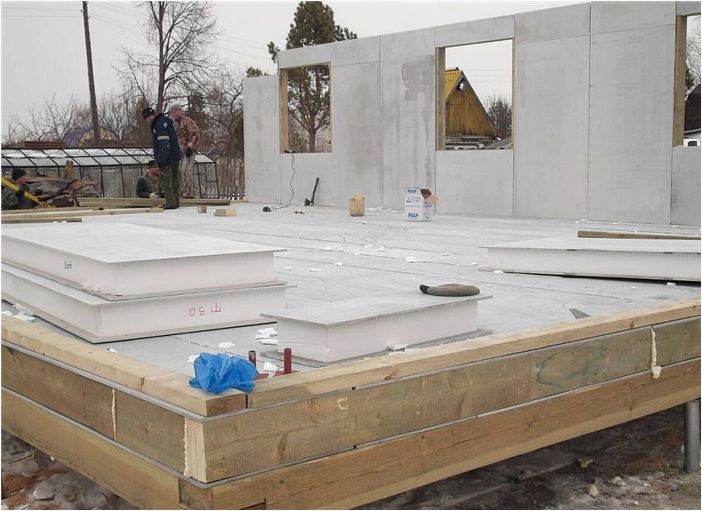
The main disadvantage of using such “pies” is the low ventilation panels. Without forced ventilation, excess moisture accumulates in the house and the air becomes musty.
LSTK frame – a dubious replacement for wood
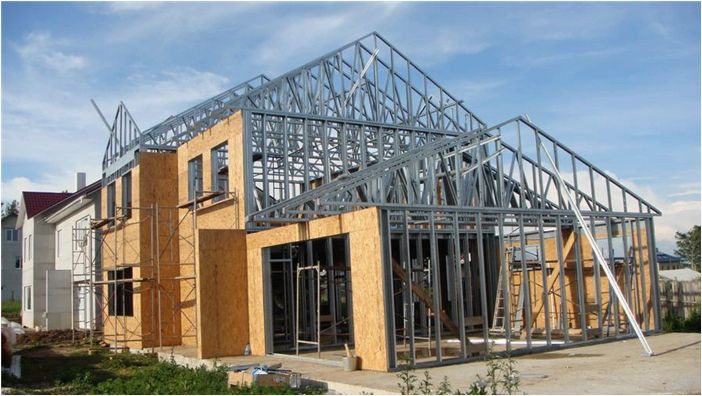
Houses made of light steel thin-walled structures (LSTC) make up about 6% of the total number of frame structures. Metal frames are not used to replace wooden beams. It is more correct to consider them as a more affordable alternative.
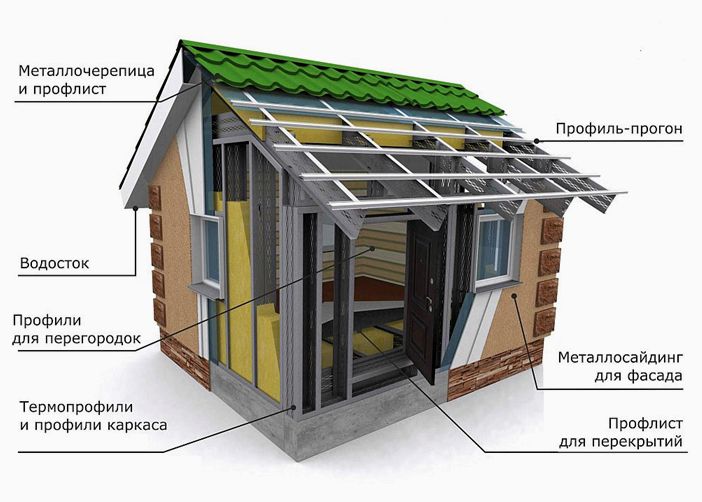
Compared to wooden frames, steel frames have more disadvantages than advantages. The main drawbacks are:
- High thermal conductivity. Metals cool significantly and heat up quickly when the temperature rises. This problem can be partially solved with high-quality thermal insulation, but independently performing accurate thermal insulation calculations and determining the dew point is quite difficult.
- Frame magnetization. Equipping a house with appliances located parallel to the metal structure may seem inadequate to residents.
- Poor fire resistance. Paradoxically, in the event of a fire, metal frames perform worse than wooden ones. It quickly loses rigidity, causing the house to spin and twist, reducing evacuation time.
- Corrosion. Light gauge steel framing manufacturers claim to solve this problem by galvanizing the metal structure. However, in practice, sudden corrosion has been observed.
Don’t forget about the ability of metals to conduct electrical discharges. To eliminate the risk of electric shock, a potential equalization system is required, the installation and calculation of which should be done by professionals.
Experience in building a frame house: the reality of self-assembly
Frame houses only live up to expectations thanks to competent design and construction. Without experience, don’t expect to build a sturdy house in a few months. Nuances that aren’t a problem for professionals can become a stumbling block for beginners.
It’s clear that hiring specialists can significantly increase costs, but in some situations, saving money isn’t practical.
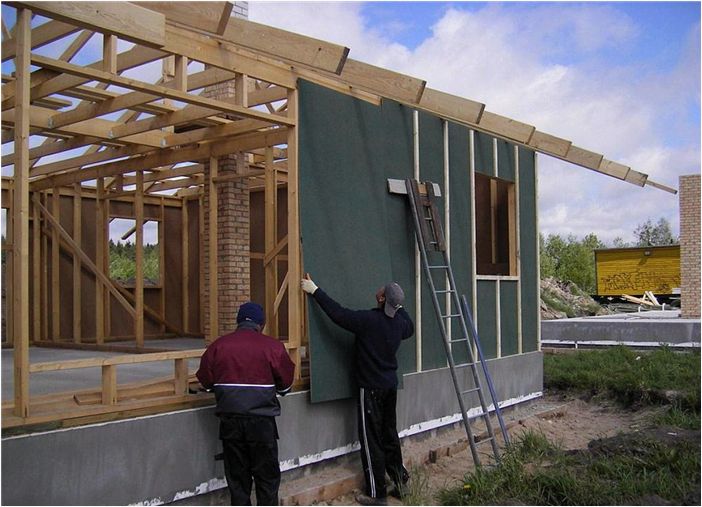
- It’s better to test your skills and gain experience by reducing the number of copies—time, bathhouses, sheds, etc.
- You need to commission the construction of a two-story building or a house with an attic for permanent residence. Calculation errors and lack of integration of technologies can be costly.
- Summer cottages can be built independently using a ready-made design and having previously agreed on a work plan with a specialist. It’s advisable to use home economics with detailed sketches, installation diagrams, etc. Residents’ reviews of timber-frame houses
Reviews from residents about frame houses
Heating savings – energy-efficient technology has proven its effectiveness; the house warms up quickly and retains heat better than a brick structure.
- Fast construction, a wide choice of layout options and facades – many choose turnkey houses and entrust all the work to a professional company.
- Costs are lower than for brick cottages or log houses.
- Among the nuances of operation, in most cases, tenants at such moments remain dissatisfied.
The presence of sound insulation and minor vibrations when hitting the walls.
- The need for efficient ventilation systems, preferably with heat recovery.
- Difficulties with placing heavy objects on the wall – it is better to strengthen stationary objects further.
- In general, this technology fully justifies itself – the advantages of a prefabricated house are more important than its disadvantages. The frame design offers an optimal balance between price and quality. If the price of traditional wooden house construction increases every year, then the cost of frames is gradually decreasing due to greater competition in the market. Now to
buy frame house , just go to the Terem Group website and view the catalog of ready-made projects before placing an order frame, houses, acquaintance, technology