Parquet boards: recommendations for choosing, pros and cons

Recently, parquet boards have become one of the most popular types of flooring due to its environmental friendliness, excellent performance aspects, and decorative features. Our online store presents parquet boards from leading European companies: Germany, Finland, Sweden, Belgium, Holland, Hungary, Belarus and Russia.
In terms of its external and strength characteristics, a high-quality parquet board can completely replace an array of valuable wood species, appearing at the same time as a more economical material. At the same time, the cost of parquet boards can be an order of magnitude less.
What you need to know about parquet boards

Parquet board is a completely natural finishing material, consisting of several (usually three) layers of wood of different types. The adjustment of the layers is done in order to prevent their deformation during operation. The first production of laminated parquet was organized in 1941, but the true heyday of this business occurred only at the beginning of this century.
The essence of the method is that valuable wood is used only for the top layer (up to 4 mm thick), and the middle and bottom layers are made from less valuable species, usually conifers. Due to the fact that the middle layer has a transverse direction of the fibers, and the top and bottom have a longitudinal direction, the strength of the product increases repeatedly.
Features of the production of high-quality parquet boards
Reputable manufacturers organize the production of parquet boards in several stages (at least seven), each of which ends with quality control of technological operations:
- Selection of wood for each layer;
- Technological drying of raw materials (carried out over a period of one and a half months using steam) and heat treatment to form a thick amber tint and compact the original wood;
- Sawing up blanks with subsequent sorting by quality and shades;
- The assembly of the parquet board is done automatically by sequential gluing of layers. The finished mass is steamed and pressed until the required hardness is obtained. Then the top layer is puttied, brushed if necessary and undergoes final sanding;
- Finishing – impregnation of the top layer with special oils and varnishing in several layers;
- Shaped processing of lateral longitudinal sections to form interlocking connections;
- Packaging of finished products ensuring safe transportation.
Types of parquet boards
Based on the surface pattern, parquet boards are classified as:
- Single-strip – the top layer consists of one solid plank;
- Two-strip – the top layer is made up of two rows of planks (short or long);
- Three-strip – three planks wide on the top layer (available in different color combinations).
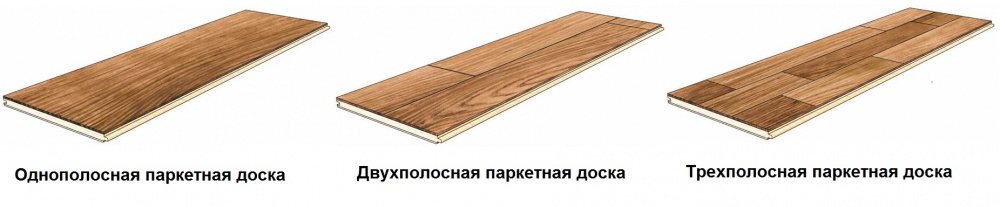
Comparative characteristics of parquet flooring with different plank patterns

| Parquet board structure |
|---|
Number of planksPlank arrangementVarietiesGeneral appearance of laid parquetFeaturesPossible installation directions in a room
Single-strip
1
Longitudinal
Classic
Resembles a classic solid wood floor
_
Longitudinal, crosswise, diagonal, herringbone, complex installation
Single-strip
1
Longitudinal
Deck
Resembles a ship’s deck
Some models have decorative inserts in the form of colored wooden “plugs” and a contrasting thin edging along one edge
Longitudinal
Two-strip
2
Longitudinal
Deck
Resembles a solid wood floor
Strips are arranged one under another, without any length offset
Longitudinal, crosswise, used for complex installation
Two-strip
2
Longitudinal
Staggered
Resembles a block parquet
Second row Strips shifted by half the previous row
along, across
three-strip
3
Longitudinal
Staggered
Resembles a block parquet
each row is shifted relative to the previous one
Longitudinal
multi-strip
from 4
Longitudinal
–
flooring made of small wooden planks
has a unique design, inherent only to this type of flooring
Longitudinal
Danish (Dutch) pattern
1-3
along and across
various types of “weave”
resembles block parquet – weave
planks are arranged in squares or cells perpendicular to each other
according to the desired pattern
modular parquet
various
according to the pattern
huge quantity
resembles block parquet laid in a complex manner
may contain inserts of a contrasting color
according to the pattern
Each type of parquet board helps create an individual floor pattern, while the price of the finishing material decreases with increasing Number of strips.
Variety Criteria
When choosing parquet flooring for your home or office, it’s best to consider products from reputable manufacturers to ensure the quality and durability of the material. High-quality parquet flooring options differ not only in the wood species used for the top layer, but also in the selection (the method of cutting and laying the planks in a specific pattern), as well as the desired finishing style (aged, country style, classic, etc.). The finish—oil or varnish—is also important.
Installation and subsequent maintenance
Despite the apparent simplicity of assembling a floor from a parquet board, it is better to entrust the work to a master, since most of the nuances and rules are present. To care for a parquet floor, you need to use dry cleaning and use wet cleaning with caution (with a cloth wrung almost dry).
The structure of the parquet board
Such a finishing material is not essentially a piece of parquet or solid wood, since it has a two or three-layer sandwich structure. Most often, three-layer options are found on sale.
- The lowest layer is 1. 5 cm thick plywood made from spruce, pine or birch. It gives parquet elements strength and protects them from deformation.
- The middle layer is usually 8. 9 mm thick and is made of wooden slats laid parallel to each other. This structure allows the parquet board to gently “spring” underfoot and not leave marks on its surface from contact with heavy objects. In some models intended for use in fairly high traffic conditions, it is made of HDF board.
- The top layer is made from veneer of trees of different species. Its thickness can vary from 0. 5 to 6 mm. The most common version of veneer is four-millimeter; it can be sanded and scraped. Sometimes the surface of the wood is tinted to give traditional wood floors the appearance of being made from mahogany, wenge or merbau.
In the two-layer version (engineered board), multi-layer plywood is used as the bottom layer, and 2-3 mm veneer is used on top. Such a board is cheaper than a three-layer board, but it must be glued, which increases the cost of the work.
For ease of maintenance and protection from fading, moisture and mechanical damage, the surface of the boards is coated with varnish or oil. Both options look great and serve well; the choice depends only on the buyer’s own preferences.
How to choose a parquet board for a hall, living room or bedroom

In this case, your imagination is practically unlimited. In these rooms there is no constant contact with water and high humidity, for this reason you can choose what you like. The only condition is that the tone of the floor must be combined with the overall color scheme of the room.
Often buyers are interested in what type of installation to prefer – glued or glueless. In these rooms, the use of glue is not justified; the floor can be laid without it. But here the advantages of the glueless method will be fully demonstrated – the floors can be laid independently, and, if necessary, disassembled and reassembled in a new place.
The only condition is that the locks on such boards must be reliable, otherwise such a coating will soon creak. For this reason, when deciding which manufacturer of parquet boards to choose, pay attention first of all to the reliability of the locks. If, in the future, you plan to scrape the surface of the veneer, then its thickness should be 4-6 mm.
Which parquet board to choose for a children’s room
When choosing parquet for these premises, first of all you need to pay attention to the environmental friendliness of the coating. It is better that it is material from a well-known European manufacturer, then you will be protected from the content of toxic impurities and harmful substances.

How to choose a parquet board for the kitchen and hallway
In this case, the most important factor will be the moisture resistance of the floor covering. For this reason, it is recommended to coat the edges of the parquet board with wax when laying.
For installation, it is preferable to use models coated with varnish, as it is more difficult to leave stains on them. In addition, this floor suffers less from mechanical damage caused by contact with retractable parts of kitchen furniture.
Previously, there was a strong opinion that in such premises parquet could only be laid with glue. However, with the introduction of new construction technologies and the production of special products for sealing joints, it has become possible to lay parquet in the kitchen and dining room using a glueless method.

Which parquet board is better to choose for laying on heated floors?
Most well-known parquet manufacturers produce models that can be laid on warm floors with both water and electric heating. For greater stability, it is recommended to glue the board to the base.
Now buy parquet boards inexpensively at Villa di Parchetti, which is the largest supplier of high-quality premium materials: wooden flooring, interior items and partitions, entrance and interior doors.