How to choose a lamp for the kitchen
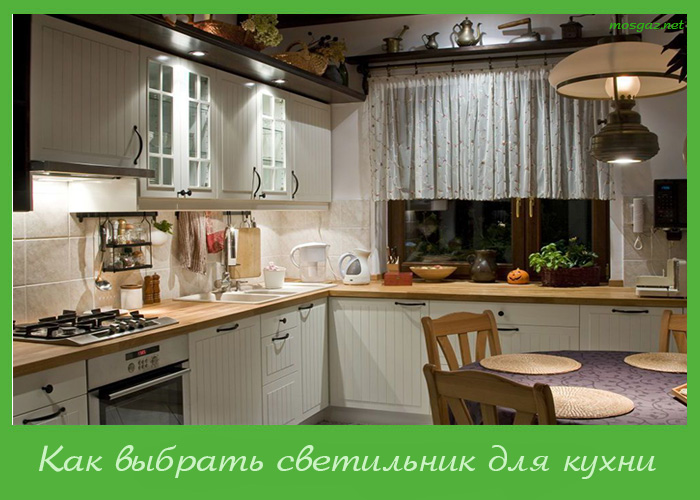
The choice of lighting for the kitchen is important not only in the “design” aspect, but above all in the household aspect. In the kitchen, people spend a lot of time manually performing numerous tasks related to cooking, baking pastries, cutting salads, etc.
For this type of operation you will need good lighting, and general lighting is usually not enough, even if powerful lamps are used. Therefore, most kitchen furniture has additional light sources that are installed above the countertop. Once upon a time these were fluorescent lamps, most often halogen lamps.
However, these lighting fixtures installed in a set of kitchen furniture do not always provide the correct lighting, and then a dilemma arises – aesthetics or practicality. A good assistant in choosing a chandelier will be the EuroStyle, where a large assortment of lighting fixtures will be a real find.
1. Install local lighting in the kitchen
If there is no desired lighting above the tabletop, installing it yourself is not at all difficult with current technology. If there are cabinets hanging above the countertop, we buy the necessary set of light bulbs for lighting, for example, halogen lamps. Next, using a drill with an attachment for drilling round holes, we drill the required size seat for the lamp, connect the power supply and everything is ready.
2. LED lighting or classic
However, there are now much better and more efficient solutions available – LED lighting (i. e. based on light-emitting diodes).
In this case, you can choose two solutions – tapes or strips. Experts recommend LED strips because they are stronger and more aesthetically pleasing.
The advantage of current LED lamps over classic incandescent lamps is visible to the naked eye:
• contrary to popular belief, LED lamps in larger quantities can provide better lighting than classic incandescent light bulbs;

• small sizes allow you to install them almost anywhere;
• They are currently the most efficient form of lighting, thereby limiting the amount you pay for electricity, which, as we know, is constantly becoming more expensive.
Nowadays, LED lamps look like classic incandescent lamps because they are composed of a large number of diodes. Modern diodes are actually tiny—simple glowing micro-dots.
This lighting solution is equally well suited for so-called kitchen islands—if there’s some kind of cornice above the island, then it’s easy to place a row of LEDs underneath, which would be quite difficult with other lighting solutions.
3. Ceiling Lighting in the Kitchen
LED modules are well suited as ceiling fixtures, although classic halogen lamps are still used in suspended ceilings, while LEDs are currently being used to illuminate walls for aesthetic effects. Nothing stands in the way of using both technologies.
Well-placed LED ceiling fixtures can completely replace the need for a main light source. If you prefer a central point of illumination, you can use commercially available LED lamps as the main source. LED bulbs are available with standard screw threads, similar to those found on conventional incandescent bulbs. Properly designed kitchen lighting using LEDs can save significant amounts of electricity, and therefore money.
Power consumption can even be significantly lower than with energy-saving bulbs. Keep the environment in mind, too…