Immersion sleeves for temperature sensors
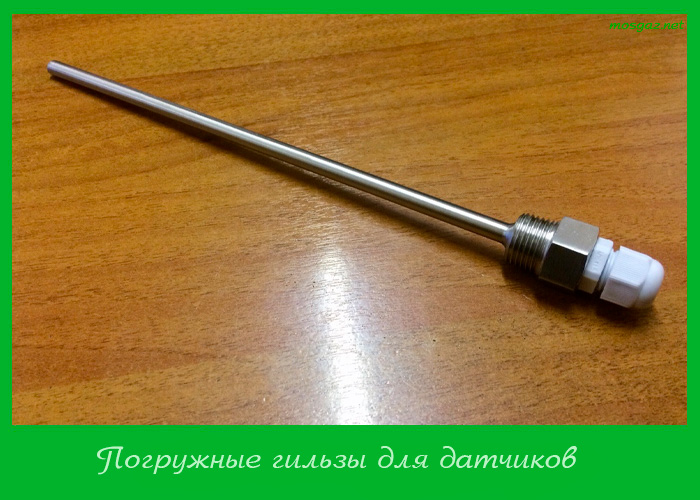
Mounting sleeves are used to install sensors in a tank or pipe.Immersion sleeves for sensors are distinguished by the type of mounting thread, installation method (welded or screwed) and material (brass or steel).
Protective sleeves
Temperature sensors are installed in protective sleeves in order to isolate them from aspects of the technological process that can damage them, namely, mechanical stresses generated by the flow of a high-pressure environment and the influence of corrosive chemicals, and occasionally introduced directly into the process environment. Thermowells are metal tubes, closed at one end, that are attached to a pipeline or process vessel and must become a sealed, required part of the pipeline or process vessel. They enable the original transmitter to be easily and quickly removed from the process installation for replacement or calibration without requiring the process to be stopped or the vessel or pipeline to be emptied.
Particularly popular types of thermowells are threaded, flanged and welded. Thermowells are classified according to the way they are connected to process equipment. For example, a threaded thermowell is screwed into process equipment; A socket-weld thermowell is welded to a welding outlet fitting, and a weld-in thermowell is welded directly to the vessel or process pipe. A flanged safety sleeve contains a flange ring that is secured to a mating flange on a pipeline or process vessel.
Types of thermowells
Thermowells are typically machined from a variety of materials and may include coatings of other materials to protect against corrosion or erosion. They are available as flanged, threaded or welded.
The rod or rod that protrudes into the process environment can be straight with a constant diameter, conical along the entire segment from the point of entry into the process medium to the tip, partially stepped or conical. Selecting the best design for a given system requires consideration of process conditions and various performance criteria.
It is the responsibility of the designer designing the system to gather all available information about expected performance and process performance before designing the system. Preparatory engineering work will provide significant benefits by enabling the design of an optimally performing temperature measurement system at the lowest cost of use.