Recessed ceiling LED lights – design options, pros and cons

One of the most important problems that modern designers have to solve is the harmonization and comfortable lighting of rooms. Modern technologies have made it possible to create lamps based on LEDs, built into suspended or suspended ceilings. They are economical, have excellent shine and, most importantly, a huge working life.
Contents of the article:

LED lightning.
What is a light emitting diode or LED lighting device?
In practice, this is a set of semiconductor LEDs assembled in plastic or metal cases. Power is supplied from a step-down transformer, which can be installed directly on the lamp body or connected separately.
Due to their technical characteristics, LEDs are many times superior to incandescent, halogen and fluorescent (daylight) lamps. For example, LED ceiling lights provide 120 lumens of output per watt of power consumption, while competitors only provide 24-25 lumens.

LED lamps with the specified reflectors do not require
The working life or service life of LED lighting equipment is 50, 000 hours of continuous operation or 6 years, according to the manufacturer’s assumptions. The service life of conventional light sources is hundreds of times shorter. The advantages of LED lamps also include the absence of inertia. This means they turn on as soon as they are turned on, meaning energy storage and fluorescent bulbs need to be heated to achieve maximum shine.
It is also important that LEDs do not contain harmful substances that can be released when the lamp glows. This cannot be said, for example, about energy-saving lamps containing mercury.
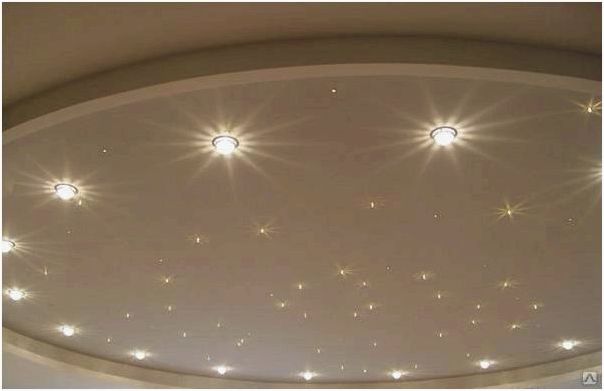
Flickering lighting using LEDs controlled by a programmer

A working LED lamp uses a small current and voltage. It has a voltage of 12-24 volts and does not pose a danger to human health if accidentally touched. As is known, failures of incandescent lamps, fluorescent and energy lamps occur when turned on, which indicates low resistance to cyclic loads. LED lamps in built-in ceiling lamps do not have this drawback Buy built-in ceiling lights you can contact the website of the Distribution company.
However, despite their numerous advantages, LED lighting fixtures also have their drawbacks. First and foremost is their high price. Although prices have dropped somewhat in recent years, they remain the most expensive lighting fixtures.

Spotlights in Plasterboard Ceilings
When using high-power LEDs, LED lamps can still heat up. This requires the use of special cooling radiators in the fixture’s housing.
As you can see, when comparing the advantages and disadvantages, the advantages of the former are obvious. The main advantage is their service life and efficiency, which allows for even greater savings.
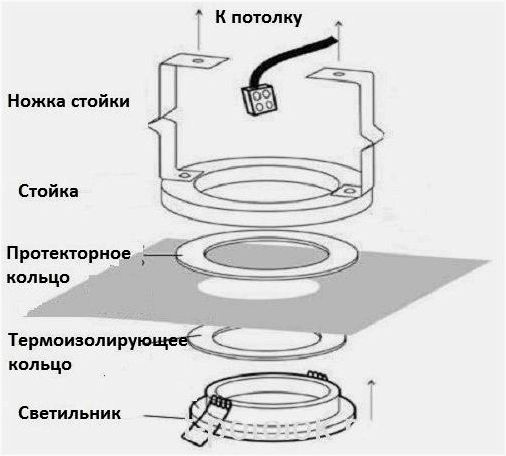
Stretch Ceiling Lighting Installation Diagrams
Types of LED lamps
The most common LED lighting fixture types are presented in this list.
- Spotlights and rotating spotlights built into the ceiling;
- Armstrong-type LED ceiling panels;
- LED strips for decorative lighting.
Energy-saving LED ceiling luminaires can use dozens of low-power LEDs or one to three high-power LEDs as the light source. A U-shaped spring is attached to the luminaire housing and secured to a rigid suspended ceiling. For installation, the spring is bent along the housing and inserted into the lower hole. Release the spring, and the luminaire is securely attached to the suspended ceiling.

RGB LED strip
Important! If the spotlight is installed on a PVC plastic ceiling panel or ARMSTRONG-type mineral ceiling tile, do not release the spring abruptly. This may damage the panel or tile.
Stretch ceilings are equipped with LED recessed luminaires with height-adjustable housings. The ceiling mount has protrusions for mounting. The LED lamps generate virtually no heat, but the ceiling panel beneath them is equipped with protective seals. Rings.
LED ceiling lights illuminate the entire ceiling, not just the space below. When positioned correctly in a suspended ceiling, the brightly illuminated ceiling appears to be elevated.
Adjustable spotlights are also popular. They can be made with one, two, or three adjustable lighting elements. They are very useful for illuminating work surfaces in kitchens, workshops, and offices. These lamps can be used to create lighting effects in specific areas and to zone rooms.
LED ceiling lamps 600×600 are analogues of chandelier lamps used in ARMSTRONG suspended ceilings. They are much lighter and many times more economical than their analogues. The illumination also exceeds that of fluorescent lamps in fluorescent shades. However, such lamps are more suitable for offices and industrial premises.

Transformers for LED strips
LED strips are usually used for decorative lighting of suspended or suspended ceilings. It is placed in a plasterboard box or on a wide ceiling plinth glued around the perimeter. Sometimes tape is placed on ceiling paintings on the second floor.
Important to know! A step-down transformer is used to supply power to the LED strips. When purchasing LED strips, always ask the seller which transformer is suitable.
To attach the LED strip to the base, an adhesive layer is provided, glued to the base. Color programmable RGB strips are also available. They use a programmer with a built-in step-down transformer.