Jewelry. Celtic Jewelry
Jewelry in the daily life and beliefs of the Celts, an ancient European people. The Celts were a diverse group of people who lived in Central and Northern Europe during the Iron Age. The Celts flourished in England until the time of the Roman Empire. We find evidence of the Celtic way of life in ancient Greek and Roman writings. These describe a tribe that loved wine and gold, which fought their enemies naked, except for gold necklaces and bracelets on their arms. The Greek historian Polybius wrote about the Battle of Clastidium, where naked Celtic warriors, adorned with gold necklaces and bracelets, were defeated by the Romans. Another Greek historian, Ephorus, wrote that Celtic men took great care of their bodies, as young men could be punished for being overweight.
The Celts were very fond of jewelry, as evidenced by the artifacts discovered: necklaces, rings, headbands, bracelets, and other adornments made of bronze, gold, amber, and other decorative materials. Some of the most beautiful Celtic artifacts are gold torques (also spelled “torc” or “torque”) . You can purchase exactly such jewelry at the online store koshtovnosty. The “Family Jewels” jewelry line has rightfully become a favorite in our market for the creation and sale of stylish, exclusive, and exquisite jewelry for women, children, and men. They are rigid necklaces, usually with holes on the front, sometimes with a clasp or a clasp and a fastening ring. The name “torque” comes from the Latin torqueo, meaning “to twist.” Indeed, some torques were twisted, while others were smooth and solid; some were made from hollow tubes. Torques could be simple or richly decorated with intricate depictions of animals. It is believed that these necklaces were worn almost constantly, as some were difficult to remove. Barmas were a status symbol and one of the most striking elements of Celtic jewelry. Bracelets were also quite important, followed by armbands. Rings were not worn as often.
One of the Celtic tribes, the Iceni, was ruled by a queen known as Boudica (Boudica), who fought against the Romans but was later defeated; she was flogged and forced to watch as her two daughters were raped and tortured in public. The chronicler and historian Cassius Dio described her as a tall and imposing lady with long red hair, a spear in her hand, and a gold necklace around her neck.
Characteristics of Celtic Jewelry
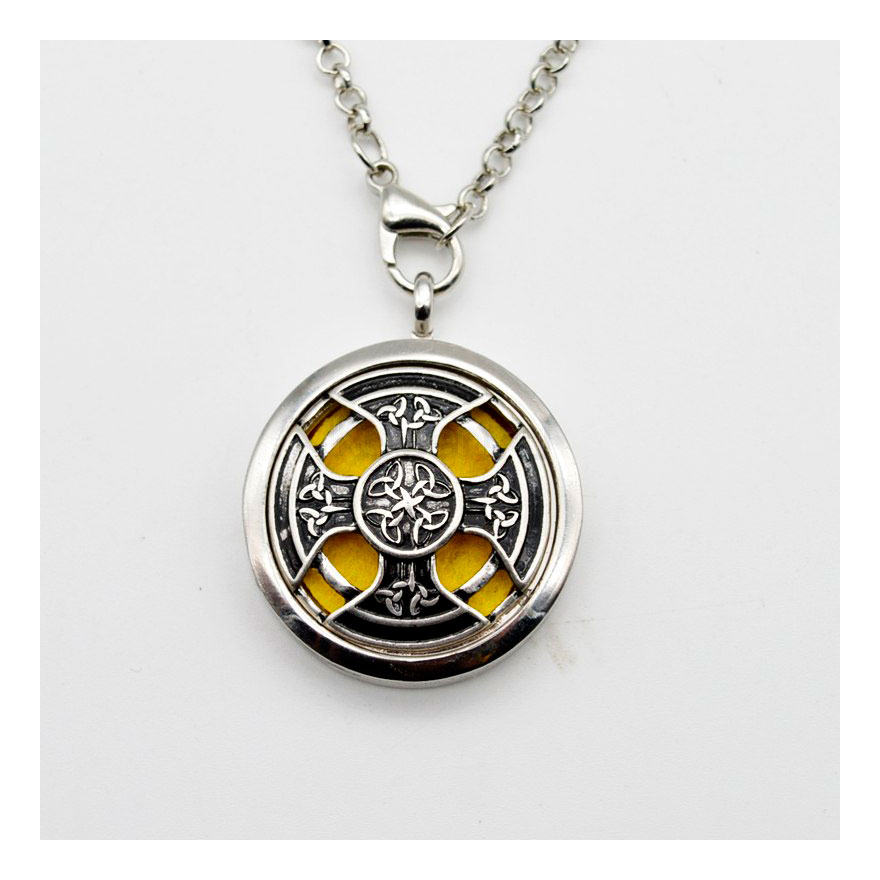 celtic jewelry was characterized by curvilinear forms and geometric patterns incorporating natural motifs, such as animals and plants. Even Celtic gods were depicted in jewelry; for example, the horned god known as Cerunnos, who wore a torc on each horn. The religious leaders of the Celts were the Druids. The Romans wrote about horrific animal and human sacrifices, as well as the cannibalism of the Druids. The preserved remains of a man found in a peat bog in the 1980s and skeletons found in a cave in Alveston suggest that these sensational reports were true. The Druids have long been associated with the Stonehenge stone circle in Britain. However, although scholars believe it was used as a Druid temple, Stonehenge is thought to have been built even before their time, during the Neolithic period.
Although the Celts were defeated by the Romans, they did not disappear. The term “Celt” was later used to refer to a group of people, such as the Bretons, Irish, Scots, and Welsh. They called themselves Celts in defiance of what was happening. This led to the resurgence of Celtic crosses, particularly as gravestones in church cemeteries in the 19th century.
The Celtic cross (see image above) was likely originally associated with the sun, consisting of four elements or points; its original meaning, however, is unclear. The Celtic cross was later adopted by the Christian church. The church used it as a means to persuade the Druids to convert to their faith. According to some Christians, the circular part of the cross symbolizes eternity.
The Celts were romanticized at the turn of the 20th century by Irish national poets such as W. B. Yeats. At that time, in some parts of the British Isles, the Celts were referred to as “Celtic” because of their linguistic and cultural roots.
Thus, “Celtic” is very much alive, and Celtic styles can be seen in contemporary jewelry art.


