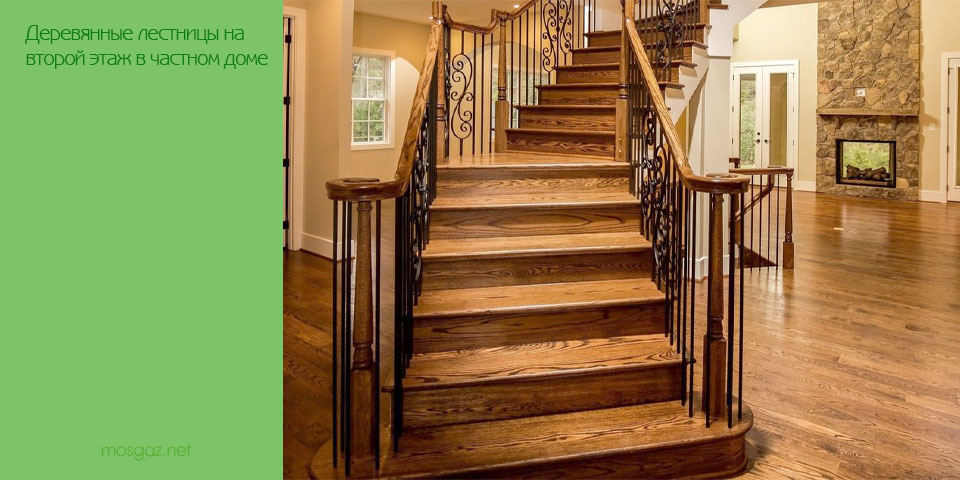
Wooden stairs to the second floor in a private house
Now we will introduce you to the types of structures, with explanations from specialists, and also show you many images of projects of manufactured stairs, developed for individual projects, and carried out by the craftsmen of the production company in their workshop. In every single house with more than one floor, it is impossible to live without a staircase. Of course, there are options for climbing to the second floor or attic using a rope, but you must admit that not everyone can overcome such an extreme descent and ascent. The staircase is extremely important and not only in the format of convenient and safe movement, many structures become a decoration of the home, the pride of the owners, a significant part of the design, a memorable and striking detail.
Modern staircases are not at all mediocre in occupying the allocated space. Directly below them there will be cabinets for storing all kinds of necessities, shelves for an impromptu library, a small utility room, a children’s corner, in a word, who needs what. A staircase is also a good way to expand the area of the house, without taking over the land from the garden and other plantings. Especially if it is a staircase to the attic, which, thanks to it, can be transformed into a useful attic.
There are a number of types of wooden structures: stylish combined, marching, modern screw, including original forging elements, plastic, tempered glass.

There are special requirements for wooden stairs, which must be followed. This guarantees completely safe and comfortable movement, with a comfortable position of the foot and support under your arm:
- To ensure one flight, even with an original design, according to a separate project, the permissible number of steps is no more than 16 and no less than 3. Steps that differ in height are not at all conceivable. The fact of their presence increases the possibility of injury.
- The very first and last steps are necessarily illuminated with lighting devices to avoid injuries and falls during the period of foot slipping.
- For an ordinary flight of stairs, a width of 1 m and an inclination angle of 25-35 degrees are considered to be convenient parameters.
- The stair railing must withstand a load of more than 0. 3 kN/m and have a height that exceeds 90 centimeters.
- The riser width should be at least 60 centimeters, as the walkway on broken or curved flights is located approximately 30 cm from the edge of the staircase.
- Spiral staircases pose challenges in the event of an emergency evacuation.
- The building code’s accepted standard for double riser height and tread width is approximately 60-65 cm.
- The landing must be at least one meter in area, and of course, larger than the flight itself.
- A staircase with the steepest incline will require significantly less space, but is less comfortable to use.
The most appropriate staircase design is created for any type of space: L-shaped, straight, modular, spiral, and U-shaped. Here, too, certain rules must be taken into account. For example, a simple, plain staircase with straight flights will occupy a fairly large area, yet it is ideal for older adults and children, as ascending and descending these stairs does not restrict their ability to move safely and confidently. Spiral staircases are certainly compact and elegant, but they can create inconvenience when ascending or descending for older family members and small children. This is an extreme case where sophistication comes at the expense of functionality. Incidentally, moving large furniture will create insurmountable obstacles. Such structures require careful calculation and a special approach.
Types of wood for steps
The aesthetic appearance of a wooden structure can depend entirely on the type of wood used in restoration work. For a pleasing result, the wood must meet the following requirements:
- the surface of the elements must be uniform, free of defects such as beetle damage, cracks, or knots;
- the wood moisture content must be no more than 12%. When the standard is too high, the material must be thoroughly dried.
Wooden steps should first be primed and then coated with two coats of waterproof alkyd enamel if they will be used outdoors.


recommendation! In areas with high loads, it is best to use blanks from a single piece of wood or laminated timber.
The following wood species are used in production:
- oak is the best material for steps. Oak stairs are very beautiful and durable, but expensive;
- beech is a material with a beautiful pattern and color scheme, subject to the influence of ambient humidity. It is recommended to use beech stair steps for interior structures;
- steps made of pine – the hardness is by no means at a high level, for this reason it is easy to process. After some time, yellow spots may appear on pine products. But you can easily find this material at an inexpensive price;
- ash – the plates are bright and hard. Actually, the bright color scares off a certain part of buyers;
- birch – quite hard samples are obtained from it. They will last a very long time, but most often large pieces cannot be made from it due to the presence of defects and differences in shades;
- larch – contains tannins in its structure, thanks to which larch steps do not deform; only the very high cost prevents the material from getting ahead among its competitors.
In conclusion
Wooden stairs will never go out of fashion; over the centuries, the products have been very popular. Oak steps are an impressive and expensive design, ready to create an even more beautiful home. If the work is done according to all the rules and with high quality, then an oak staircase will bring joy to more than one generation.